Monday, 28 November 2016

The Woman Who Went to Bed for a Year By Sue Townsend

How can you not buy a book with this title? Considering also that in the last period I feel like I can never leave the bed myself.

And also, the other book I read by Sue Townsend was hilarious (here).

The day that her children leave from university, Eva decided to go to bed and to stay there for as long as she liked, forgetting to be both a mother and a wife. Of course her decision will create first worry, then anger among her close and enlarge family. Will she ever get out of bed? Is she getting depressed? But also, who will cook food from now on? And who will clean the house.
The book is engaging at the beginning, witty and funny at times. And for half of the book I could also empathise with Eva. But after a while I found it lost all its sharpness, until the end of the book, that I found quite flat.

Pity!

The Palace of Curiosities By Rosie Garland

I saw this book in a market, was there, bright with a intriguing title, I just decided to buy it.

I don't have much to say about it, if not that this is the most CREEPY thing I have ever read. Creepy, creepy and more creepy. It is not a bad reading, I just did not understand it at all, and I had to do a big effort to finish it (considering the creepiness). 

The Little Prince- The Movie

Sometimes I should just follow my gut, I knew I did not have to watch it, I knew it.
It came out in the cinema and I didn't go, as the chance to get disappointed were too high, but then I saw the DVD on offer, and in a sentimental moment I decided to buy it.

Created an atmosphere and started watching it. The first 30 minutes were magic, WOW, they found a nice way to not simply recreate the book, but to try to interpret it, through the eyes of a little girl that discover for the first time the story of the little prince. I was impressed.
Then all goes wrong, like cold water while your are sleeping, you suddenly wake up and the magic is lost, forever...

The only was to recover was to read again the book, in bed, with nice music, to reconnect with the world...

Monday, 22 August 2016

Hitman Anders and the Meaning of It All by Jonas Jonasson

The third book of Jonasson, the third secure laugh! Oh you did it again!

As I think I said before about his books, I know that you can either love or hate them, and I do love them.

Here we meet a new funny character, Hitman Anders, a former criminal that once out of prison meets some craz(ier) people on his way that have a mission in mind: make some easy money and become rich. With a naive reception and a priest without vocation, we will be brought in a new crazy adventure characterised by Moldovan red wine and Bible quotes.
As I read somewhere, while reading this book you hope God has a BIG sense of humour!!!

Yes ok, none of his books can compare in originality and laugh with his first masterpiece, but give him a break, his books are so enjoyable that I cannot stop laughing while reading them.

You did it again Jonasson!

If you interested to read my reviews about his first two books, here are the links
The hundred year old man who climbed out the window and disappeared
The girl who saved the king of Sweden

Sunday, 19 June 2016

The Unlikely Pilgrimage of Harold Fry by Rachel Joyce

One day Harold, just retired and enjoying his lazy life, receives a letter from an old friend and colleague, Queenie, who is informing him she has cancer, and not much time ahead to live.
The letter gets him by surprise and Harold, shocked, decides to walk to the post office to drop Queenie a reply.
Things, however, take an unexpected turn, when Harold lost in is thoughts, keeps on walking, passes many post offices, and makes the  sadden decision to reach Queenie by walk (on the other side of the country) to drop her the letter in person, in the attempt to try to save her.

During the long walk to Queenie, Harold will test his strength, his will, and will analyse his life from a different point of view.

A long walk to salvation and for salvation.

Engaging, sad, at times funny, a nice introspective reading!!!


Tuesday, 12 April 2016

Mornings in Jenin by Susan Abulhawa

I finished this book last night, and the sadness has been following me throughout the day. Like it has been saddening me for the last month I have been reading it. A month, yes, because this is not a book that you can read quickly, it is painful, it almost breaks you, I had to take pauses from it for a little while, just to find the courage to read it again.
 Throughout the book I was trying to convince myself that after all this was fictional book and, as much as you can empathize with the characters, you could still try to detach from them. But the truth is that you actually can’t, because you somehow know that the characters might have fictional names, that the episodes might not have happened in that order, or in that precise way but you deeply know that this is all true, and this has all sadly happened, and I am afraid it is still, somewhere in the corner of Palestine...
And if you wanted to keep still a doubt to clear a bit your conscience, the writer will strongly clarify her position at the end of the book, and trust me I am doing you a favour by telling you this now, that the book might be fictional but Jenin is not!

We are, of course, in Palestine and the story set place in a simple family with a normal life, until war knocks at their door and ruin everything and everyone. They will find themselves to be refugee from one day to another, without having the time to think and to realize. The book spares you nothing, from the kidnapping to the torture, it will bring you straight there, in an enduring fight for survival. How the singular personalities will survive and shape is the key of the book, no one will possible be still the same and their relationship evolve and involve all the time during the reading.
A book which I found, after all, being still full of love and hope.


People often ask me why I do this to myself, why I feel I have to read what is going on around the world when reading should be primarily a pleasure and a distraction? It is difficult to give a satisfying answer to this, because it is something that I need to do, to not let the scream of humanity to be unheard.


“I know she is crying. Her tears fall on the wrong side, into the bottomless well inside her.”


P.s. another good read on the topic is this.

Saturday, 19 March 2016

All the names by Josè Saramago

When I am stressed I need to read something I know I would like, to reduce at minimum the possibility to quit the book after couple of chapters.
This only happen with Saramago and few others.
I open his books and by magic I am in someon else's mind, thinking what he/she is thinking and getting engaged in a new adventure.

In this book Saramago explores the mind of Senhor José, a low-level clerk in the Central Registry, and the only person with a name in the book, all the others characters will be only described with their job/activity or role in the story.
Saramago is like this, he does not waste time in details that do not help the story, and names here are really not important.
-while writing this post I think I have just realized one of the reason I love Saramago: I am very bad in remembering names in books!-
Senhor José has a very monotonous life, with a repetitive, boring work; he lives alone in a basic apartment just beside the Central Registry. To give a bit of spark to his life he collects news on famous person that he carefully organizes chronologically. His predictable and monotonous life will get an unexpected turn when he finds the record card of a woman that for no particular reason catches his attention. From there on, like there was an external will controlling his actions, he will start to obsessively looking for the mysterious woman, finding himself living a different life...

As usual Saramago enters into human brain, feeling and emotions with a simplicity that amazes me every time!

"Strictly speaking, we do not make decisions, decisions make us. The proof can be found in the fact that, though life leads us to carry out the most diverse actions one after the other, we do not prelude each one with a period of reflection, evaluation and calculation, and only then declare ourselves able to decide if we will go out to lunch or buy a newspaper or look for the unknown woman"

Saturday, 5 March 2016

The Modigliani scandal by Ken Follet

I used to read lots of thriller during my teens, I adored them, the engagement, the surprise, the sudden turns, then I stopped and read just a couple for years. But I could not resist to a thriller about Modigliani, which I adore, and moreover by Ken Follet.
The story evolves around the search of a lost/unknown painting by Modigliani, different people are looking for it for different reason, from the cultural one to the economical one. Between fakes and only one original, only one person will be the lucky one to find it.
Overall it was a nice reading, but must admit did not find it very engaging, a bit plain and average. 

Saturday, 20 February 2016

My life in France by Julia Child

I finished this book a while ago, but did not know how to review it (together with having basically no time at all!). The reasons are two:  the first book a reviewed on this blog was about Julia Child (you can find it here), so I grew very attached to her life and (or maybe that's why), I bought this book on a special day, in order to reconnect with France, and with the little things that I love of Paris.
It is a simple book that describe the life of Julia Child from her moving to France with her husband Paul and her first steps in the cooking career. So be prepared to that, but it is somehow so engaging that you cannot stop reading it.

Since I can still not find the right words to describe it, I found a review on goodreads by Kelly 
that describe exactly why I loved this book (and this woman), and I cite here a part:

"You love her because she always brings things back to this place of happiness and, “oh well, the show must go on!” no matter what- but the way she told the stories and negotiated herself to that place was very realistic. This was not an unrelenting “always look on the bright side of life,” montage. There were difficult people in her life, difficult spots in her marriage, difficult moments in her career- the fact that she still remembers verbatim quotes and fights from forty years earlier is telling- and she’s clear about it when she doesn’t like something or someone and why. She doesn’t have an American sense of everything will turn out all right in the end, but rather this very French tant pis acceptance that shit happens and life is shit and oh well, wade through it like a big girl. She doesn’t try to deny anything or erase it or obsess about appearing perfect when she wasn’t- which is something I find irritating about American self-help books and TV fantasies. Her philosophy about serving your food even if it comes out bad and not apologizing for is sort of the epitome of this rejection of the hide your dirty laundry ideals of the mid-century. She’s perfectly frank about her fights with Paul Child, her problems with her co-authors on the book, her difficulties with her Republican father, her failures in the kitchen and on her TV show. It isn’t in the exhibitionist way that you see so often these days either. She’s a good girl, but she won’t let herself be walked all over- she is going to have her say and that’s just fair. I don’t know if I am doing a very good job describing this voice, but believe me when I say that it is as captivating in print as it is on television."

If you wonder if the book helped me in the reconnection process, I can definately give you a positive answer. Thanks Julia, I needed it!!! 

Sunday, 17 January 2016

Alabarde alabarde by José Saramago

The book you wish you never had to read. The last incomplete book Saramago wrote before he died, it is only 3 chapters with few note of the author but somehow you already love the characters.
It was a very hard reading, because every page I was hoping I would turn the page and there would  still be many more to read...but eventually it had to end, incomplete with a quite clear idea of where he wanted to go, but with lots, too many questions of how he would have gone on with the writing.

In the Italian version (I am not even sure it was translated in English) there is a note from Roberto Saviano, the author of Gomorrah, at the end of the book. The note is full of love, admiration and hope and this made the book even more intense.
You are missed Saramago, you are so missed...

A Supposedly Fun Thing I'll Never Do Again by David Foster Wallace

On the line that connect people through books, I got this as a gift from somebody  I do not know in person, but that seems to know quite well what I like to read.

I wanted to read it for a while, fascinated by the title mainly, being quite ignorant on the magnificence of the author and all his fame.

This book is a reportage of the author's life on a fancy cruise in the Caribbean. where he is suppose to explore the "fun" the cruise promised.
We understand from the beginning that he is not the cruise-type, and the way he describes the people and the situations on this huge ship, will put a constant smile on your face.
The highlights of the book are the author's footnote, that become actually the main part of the book, the most clever, sharp and funny.

Perfect book to read on a trip, which is exactly what I did.

Thursday, 10 December 2015

Wake Up, Sir! By Jonathan Ames


When I have friends over I always bring them to Shakespeare and company. It is my little Parisian treasure. This time was not different, I had a dear friend visiting, during a very tough period for this city and for all of us, so I brought her there to show her this place of peace. We straight decided to buy a common book to read "together" in distance. The choice was literally like this "tell me a letter and I will show you which book will decide to be read by us". The letter was the A, this book "jumped out" from the crowd to be read (with her big amaze).
I thought it was the perfect book, light but not ordinary.
So we started it together in two different countries. I have just finished it, she is almost there. During the all reading we would share impressions and quotes.

Alan Blair is an alcoholic and a writer, in this order. One day he decides to start a trip with his valet Jevees. The initial intentions are very good, they will get a bit of fresh air and he will eventually find the concentration to finish his second novel. However, things get an unexpected turn from the beginning of the trip and Alan will start to display all the strange aspects of his temper. You might think the book is all around Alan, but I found the main character being his valet, Jeeves, the detached but caring man who helps Alan to face all his adventures (mostly turning into problems).

I found the book very enjoyable, easy to read but never predictable, and it made me smile all the time ( and I really needed that in this period!). Critics say Jonathan Ames is the modern Wodehouse, I found this book being in between Jonas Jonasson's books for this series-of-unfortunate-events' s style  and the Barney's Version by Mordecai Richler for the on-the-edge- effect of alcohol (both books I actually think were written after this, so the inspiration might be reverse).

He walked me to the door. He said, "I'll miss you until I see you again."


Friday, 9 October 2015

SLEEP by Haruki Murakami

Me and Murakami have a very difficult relationship.  It started few years back when a friend gifted me "Norwegian wood". It is like this: I read him, I don't dislike him, or his writing, but when I finish his books I am always like: and so?. I also created a book club to read "Kafka on the shore" to try to discuss with others on what I was missing of this writer.  If you are asking why I tell you it is because I really want to find what people love of him, and I don't.
So I had given up, untill my mum gave me this little book full of nice drawings, and I decided to give him another try. I started the book and I really liked it, I was so much into this magic story, these nice drawings making you live in a dream.  Then I reached the last  page and I wanted to scream at him:  you did it again  Mr. Murakami, you cheated me!!. One thing is to finish with an open end, another is to not finish a book,   'cause this is exactly what he does for me.
I am sorry, I just can't see it, I just can't!
Actually from today I stop to be sorry about it, he is just not for me...

Monday, 14 September 2015

Everything Is Illuminated by Jonathan Safran Foer

Just finished to read the book, and mixed feeling are crossing my mind right now, from "wow nice book!" to "what was that?". And I really don't know which one is going to win.
I started this book couple of times and every time I would stop it 'cause I wouldn't really understand what I was reading; Then this time I decided to give it a more serious chance. I still didn't understand what I was reading for half of the book, then, all of a sudden, I was not able to put the book down: literally! I missed my stop on the metro, I sneaked a read during the breaks at work, I read while walking....till today it ended, on my bed, while I still had the coat on 'cause I just didn't want to waste time removing it.
It made me think at times, cry at others, laugh really little, most of the time it kept me wondering, till the end, when I thought it would finally be all clear...and it wasn't, or maybe yes...


“Once you hear something,
you can never return to the time before you heard it.”

Saturday, 29 August 2015

Wild Swans: Three Daughters of China by Jung Chang

I think heavy books in respect to smaller books have a bigger responsibility. More than others they have to be worth the reading and the carrying, since they imply generally you have to carry an extra bag just for the book. So I think writers should put extra care.
This is absolutely the case here! A heavy book, but more for its content than for the weight. A heavy, hard-at-times, reading about one century history of China pre- and post-Mao. All of this is explained through the life of three strong women of the same family: the grandmother, the mother and the daughter.


The story is told by Jung (the daughter) and the events are explained for what they are, but also for what they were thought to be: a critical explanation of Communism, with its advantages and disadvantages. 
Jung's parents were both actively  involved in spreading Communist's propaganda and its settlement. This meant that all the actions of the all family were fully controlled and checked to be sure they were not going against the Party. With almost-absent parents and a climate of indoctrination, Jung, at the beginning without realising, then more openly, tries to understand and discover what really freedom means and what could be the best way to reach it. This was not at all easy, in an environment where information was censored and bias and hard work was thought to be the only way to support the cause and fully devote to Mao and the Party.
An important book and testimony of China's history!

I read many reviews charging the book for the flat writing, almost without emotions, however, for me this is what I liked most of the book. A book that goes straight to the point, without fripperies, but that still has the power of emotions. Great reading!

Sunday, 19 July 2015

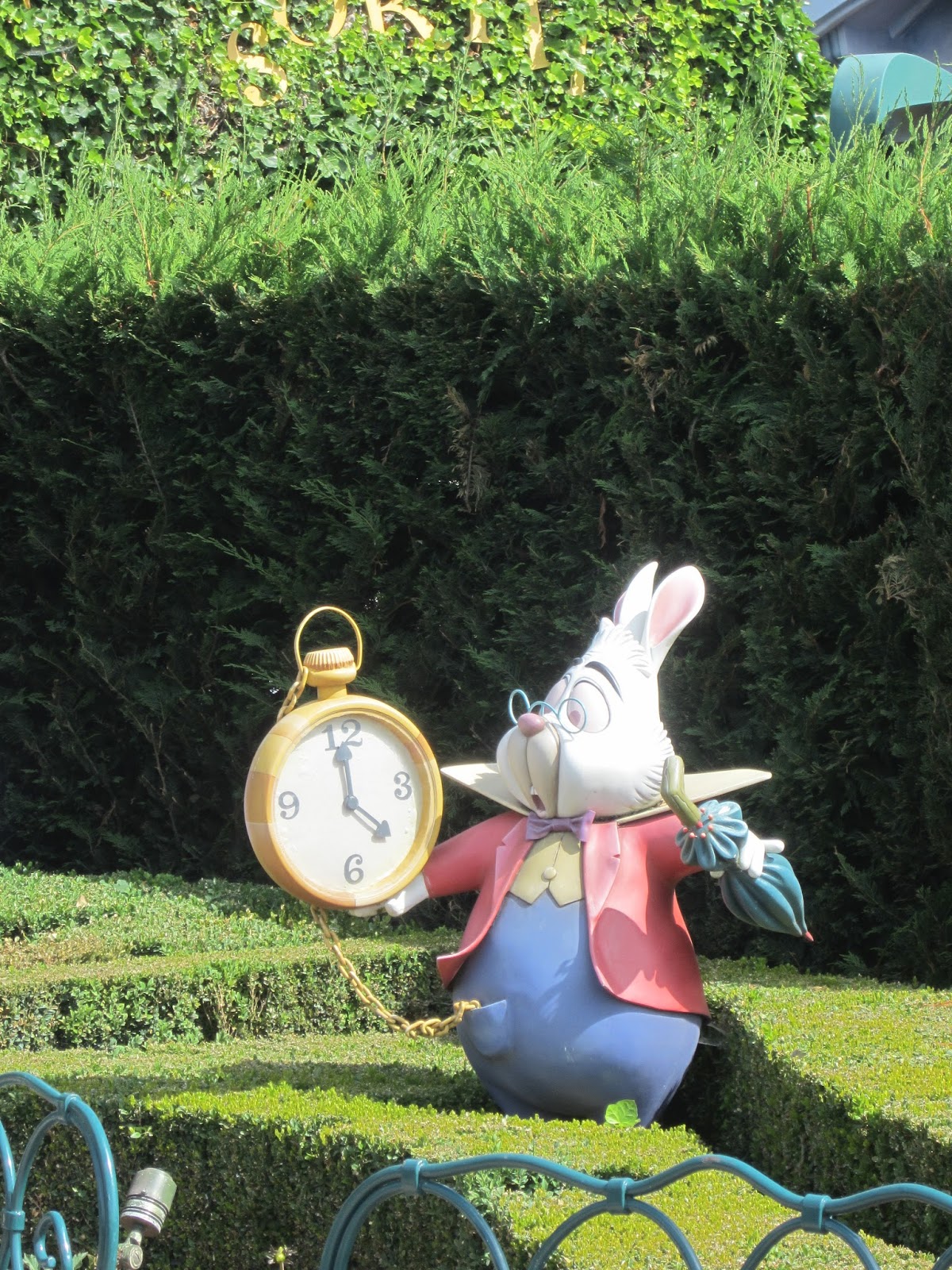
Alice in Wonderland and Through the Looking Glass (the book, the movie and so on)

During my childhood, instead of falling in love with Cinderella and Snow White, I used to watch all the time Alice in Wonderland and Mary Poppins (with the addition, as I grew up, of Back in the Future and Rocky Balboa). I knew all the lines by heart, and even now when I watch them, I can repeat most of the script. So once in a while I like to go back in wonderland!
Emotionally I go there very often, when I want to escape this mad world ("but you must be mad too to imagine it"), "physically" I have been recently there: I was in the cup of the Mad Hatter tea party, in the Cheshire Cat's labyrinth and down the rabbit hole, a dream I had since I was a kid.


I read the book many times, in many versions, but those riddles and rhymes are able to enchant me every time. The main questions that follows Alice every where are: who she is and where she ought to go, the most normal and easy questions in "our" world, but there underground nothing seems as it is.
There is actually a book, not as famous as Alice in Wonderland, that tries to find out who Alice is, and if she is at all happy of being Alice in Wonderland (Alice I have been by Melanie Benjamin), which I recommend to have a better idea of the life of Alice.

Few have actually read the sequel of Alice in Wonderland, Through the Looking Glass, which I find at times nicer than the first book. And without reading it, it is hard to realise that the Disney cartoon and, even more Tim Burton's movie, represent lot of facts happening in the second book. For instance while watching the movie by Burton, you might have asked your self who is this Jabberwocky. Well it is definitely not an invention of Burton, but rather a mysterious riddle you find at the beginning of the second book, with a note of the author that I will not spoil it for you here.
I was indeed amazed to discover that the Cheshire Cat sings this poem in the Disney's cartoon (video here).
If you are interested there are a couple of old movies adapted from the second book (one is here)

Spoiler Alert (jump if you wish): Since we are talking of Burton's movie, let's get this straight: if he would have called the movie by a different name, something like "Alice BACK in Wonderland" or the sequel, I could have watched it with a different spirit, but please Alice and the Mad Hatter cannot fall in love, even if the Mad Hatter is Johnny Depp!!! Without even talking of how badly the Cheshire Cat is represented. Apparently the sequel of the movie is going to be released next year and I am afraid of watching it.


'Who are you?' said the Caterpillar.
This was not an encouraging opening for a conversation. Alice replied, rather shyly, 'I—I hardly know, sir, just at present— at least I know who I was when I got up this morning, but I think I must have been changed several times since then.'
'What do you mean by that?' said the Caterpillar sternly. 'Explain yourself!'
'I can't explain myself, I'm afraid, sir' said Alice, 'because I'm not myself, you see.'
'I don't see,' said the Caterpillar.
'I'm afraid I can't put it more clearly,' Alice replied very politely, 'for I can't understand it myself to begin with; and being so many different sizes in a day is very confusing.'
'It isn't,' said the Caterpillar.


Friday, 19 June 2015

Cain by José Saramago

Here we are with the second "religious" book of Saramago (the first was reviewed here). This time we go back to the Old Testament and to the story of Cain and Abel.

Cain, after killing his brother out of envy, will be convict by god in person (with a small g) to never find peace and to roam around the world. He will be present to the most important events described in the Bible as a witness of the violence and selfishness of the aforementioned god (still the one with small g).

Samarago is clearly in contrast with religions in general and his books show it very strongly, but he never gives his opinion on the matter, he writes in a way that makes the reader feel he is the one to express such doubts and uncertainties.

Saramago is never disappointing, I love his style, his way to not use punctuation and strong rules of writing, and I know that most people give up on him for the same reasons.  However this is not his best book so it is suggested for people that already love him.

So when they ask me what I see in him that people don't understand I always suggest to read the "The double" so far the best book I have read by him, but the list can be very long...

Saturday, 13 June 2015

Palestine by Joe Sacco

I feel very small in writing this review, because this is not a book, nor a graphic novel, this is, as it was cleverly defined, a "graphic reportage".  And how do you review history and journalism?

You open the book and you are in the Gaza Strip, during the first intifada, but for a change you are looking at the side of the Palestinian, trying to gain back their freedom.

You will know stories of people who lost everything, from the roof on their head, to their job, their land, and often even members of their families.
How does the population react to this invasion? They throw stones!When Sacco asks them what do they think to achieve by doing so (if not to be arrested and tortured) they just tell him that this is the only way they have to be heard and not completely submitted.

Everyone should read this book, to have a different point of view. I obviously don't know where the truth stand in this battle but I promised my self to be more informed on the topic to better understand.
My personal opinion is of course that bringing peace via violence is never the solution, as history shows us every day, equality should be the universal answer!!!
 I recommend to watch this video to understand a bit more.

Sunday, 24 May 2015

Wild by Cheryl Strayed

A woman (Cheryl), after her mother's death and the resulting series of unhappy turns her life will take, decides to start a long solo hiking over the Pacific Crest Trail to find a new dimension and a new strength. Cheryl has no experience, no training for such an adventure and this would clearly be a big problem on the hiking, but her strong will and motivation, will help her to eventually keep on hiking, step by step.
Will she find herself? Will she find the inner strength to get her life back?

An engaging memoir that flows quite well, however nothing wowing.

I decided to start to read this book in a week I knew I would travel quite much, to feel a bit more the experience. So the book has been with me in 3 countries, on plane, bus, train and by walk, from 6 degrees to 20, with rain, wind and sun: I did my personal "hiking" as well.

An adaptation of the book has become a movie.

Friday, 8 May 2015

The extraordinary journey of the fakir who got trapped in an Ikea wardrobe by Romain Puertolas


I bought this book caught by the title, a clear reminder to The Hundred-Year-Old Man Who Climbed Out the Window and Disappeared.
If you need a nice, quick reading, this might be the book for you.

Ajatashatru the fakir lands in Paris with a specific mission: to buy a new bed of nails from Ikea. So when he asks the taxi driver at the airport to bring him directly to Ikea, the shock of the driver would be ours: Ikea? Really? You are in f***ing Paris and the first thing you want to visit is Ikea?

Oh well, like the driver, we would think that after all it is not our business, and indeed it is not, so let's bring him to Ikea.
Filled with curiosity we will just follow him to see what he is up to (the taxi driver will leave for the moment, at least till he realises that the fakir had tricked him).


We will discover that the fakir is planning to sleep in Ikea, where, to avoid to get caught, he gets trapped in a wardrobe: it will then start his funny, absurd, definitely-atypical trip around Europe and more, that would put his life in danger but would also bring a personal growth and maturity.

The book reads very fast, it is funny, at times sparkling and it also carries a very serious and sad meaning, although not so original, as it recalls, a lot, ‎Jonas Jonasson's books.